The Art of Computer Programming Volume 2 Seminumerical Algorithms
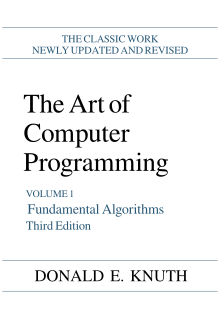 The Fine art of Computer Programming, Book 1: Key Algorithms | |
| Author | Donald Knuth |
|---|---|
| State | The states |
| Linguistic communication | English |
| Genre | Non-fiction Monograph |
| Publisher | Addison-Wesley |
| Publication date | 1968– (the volume is still incomplete) |
| Media type | Print (Hardcover) |
| ISBN | 0-201-03801-three |
| Dewey Decimal | 519 |
| LC Course | QA76.75 |
The Art of Calculator Programming ( TAOCP ) is a comprehensive monograph written by the reckoner scientist Donald Knuth presenting programming algorithms and their analysis.
Knuth began the project, originally conceived as a single book with twelve chapters, in 1962. The first iii volumes of what was then expected to be a vii-volume set were published in 1968, 1969, and 1973. Work began in hostage on Volume 4 in 1973, merely was suspended in 1977 for piece of work on typesetting prompted by the second edition of Book 2. Writing of the final copy of Volume 4A began in longhand in 2001, and the beginning online pre-fascicle, 2A, appeared later in 2001.[ane] The first published installment of Volume iv appeared in paperback equally Fascicle 2 in 2005. The hardback Volume 4A, combining Volume iv, Fascicles 0–iv, was published in 2011. Book 4, Fascicle half dozen ("Satisfiability") was released in December 2015; Volume 4, Fascicle 5 ("Mathematical Preliminaries Redux; Backtracking; Dancing Links") was released in November 2019.
The published Fascicles 5 and 6 are expected to make up the commencement ii-thirds of Volume 4B. Knuth has not announced whatever estimated engagement for release of Volume 4B, although his method used for Volume 4A is to release the hardback volume erstwhile later release of the paperback fascicles contained in it. Near-term publisher estimates put the release date at May or June 2019, which proved to be incorrect.[2] [3]
History [edit]

After winning a Westinghouse Talent Search scholarship, Knuth enrolled at the Case Plant of Technology (now Case Western Reserve University), where his functioning was so outstanding that the faculty voted to award him a primary of scientific discipline upon his completion of the bachelor degree. During his summertime vacations, Knuth was hired by the Burroughs Corporation to write compilers, earning more in his summer months than full professors did for an entire twelvemonth.[4] Such exploits made Knuth a topic of give-and-take among the mathematics department, which included Richard South. Varga.
In January 1962, when he was a graduate student in the mathematics section at Caltech, Knuth was approached by Addison-Wesley to write a book about compiler pattern, and he proposed a larger scope. He came up with a listing of 12 chapter titles the same 24-hour interval. In the summertime of 1962 he worked on a FORTRAN compiler for UNIVAC. During this time, he also came up with a mathematical assay of linear probing, which convinced him to present the material with a quantitative approach. Afterward receiving his PhD in June 1963, he began working on his manuscript, of which he finished his starting time typhoon in June 1965, at 3000 hand-written pages.[5] He had assumed that well-nigh five hand-written pages would translate into one printed page, but his publisher said instead that about one+ 1⁄ii mitt-written pages translated to 1 printed page. This meant he had approximately 2000 printed pages of cloth, which closely matches the size of the first three published volumes. The publisher was nervous well-nigh accepting such a projection from a graduate pupil. At this point, Knuth received support from Richard S. Varga, who was the scientific adviser to the publisher. Varga was visiting Olga Taussky-Todd and John Todd at Caltech. With Varga's enthusiastic endorsement, the publisher accepted Knuth'south expanded plans. In its expanded version, the volume would be published in seven volumes, each with merely one or ii chapters.[6] Due to the growth in Chapter 7, which was fewer than 100 pages of the 1965 manuscript, per Vol. 4A p. vi, the plan for Book 4 has since expanded to include Volumes 4A, 4B, 4C, 4D, and possibly more.
In 1976, Knuth prepared a second edition of Book 2, requiring it to be typeset again, just the style of blazon used in the kickoff edition (called hot type) was no longer available. In 1977, he decided to spend some time creating something more than suitable. Viii years subsequently, he returned with TEX, which is currently used for all volumes.
The offer of a so-called Knuth reward check worth "one hexadecimal dollar" (100HEX base 16 cents, in decimal, is $2.56) for whatever errors establish, and the correction of these errors in subsequent printings, has contributed to the highly polished and still-authoritative nature of the piece of work, long after its showtime publication. Some other characteristic of the volumes is the variation in the difficulty of the exercises. Knuth fifty-fifty has a numerical difficulty scale for rating those exercises, varying from 0 to fifty, where 0 is piddling, and 50 is an open question in gimmicky research.[7]
Knuth's dedication reads:
This series of books is affectionately dedicated
to the Type 650 figurer in one case installed at
Case Institute of Technology,
with whom I take spent many pleasant evenings.[a]
Assembly language in the book [edit]
All examples in the books use a language chosen "MIX assembly linguistic communication", which runs on the hypothetical MIX computer. Currently, the MIX computer is existence replaced by the MMIX reckoner, which is a RISC version. Software such every bit GNU MDK exists to provide emulation of the MIX architecture. Knuth considers the use of assembly linguistic communication necessary for the speed and retentivity usage of algorithms to be judged.
Critical response [edit]
Knuth was awarded the 1974 Turing Accolade "for his major contributions to the analysis of algorithms […], and in particular for his contributions to the 'art of computer programming' through his well-known books in a continuous series past this championship."[viii] American Scientist has included this work amid "100 or and then Books that shaped a Century of Scientific discipline", referring to the twentieth century,[9] and within the information science community it is regarded as the first and withal the best comprehensive treatment of its subject field. [ failed verification ] Covers of the third edition of Book 1 quote Bill Gates as maxim, "If you recollect y'all're a really good developer… read (Knuth's) Fine art of Computer Programming… You lot should definitely ship me a résumé if you can read the whole affair."[ten] The New York Times referred to it as "the profession'due south defining treatise".[11]
Volumes [edit]
Completed [edit]
- Volume one – Fundamental Algorithms
- Chapter 1 – Basic concepts
- Chapter 2 – Data structures
- Volume 2 – Seminumerical Algorithms
- Chapter 3 – Random numbers
- Chapter iv – Arithmetic
- Volume 3 – Sorting and Searching
- Chapter 5 – Sorting
- Chapter vi – Searching
- Volume 4A – Combinatorial Algorithms
- Chapter vii – Combinatorial searching (part 1)
Planned [edit]
- Volume 4B... – Combinatorial Algorithms (chapters vii & 8 released in several subvolumes)
- Chapter seven – Combinatorial searching (continued)
- Affiliate viii – Recursion
- Volume 5 – Syntactic Algorithms
- Chapter 9 – Lexical scanning (besides includes string search and data compression)
- Chapter x – Parsing techniques
- Book half-dozen – The Theory of Context-Free Languages
- Volume 7 – Compiler Techniques
Chapter outlines [edit]
Completed [edit]
Volume 1 – Fundamental Algorithms [edit]
- Affiliate ane – Basic concepts
- 1.1. Algorithms
- 1.2. Mathematical Preliminaries
- 1.two.ane. Mathematical Induction
- i.ii.2. Numbers, Powers, and Logarithms
- 1.2.iii. Sums and Products
- ane.ii.4. Integer Functions and Unproblematic Number Theory
- 1.two.5. Permutations and Factorials
- 1.2.six. Binomial Coefficients
- 1.2.7. Harmonic Numbers
- 1.2.8. Fibonacci Numbers
- 1.2.9. Generating Functions
- ane.ii.ten. Analysis of an Algorithm
- 1.2.11. Asymptotic Representations
- 1.two.eleven.i. The O-notation
- i.ii.11.2. Euler's summation formula
- one.2.eleven.iii. Some asymptotic calculations
- ane.three MMIX (MIX in the hardback copy but updated by fascicle 1)
- 1.3.ane. Description of MMIX
- 1.three.2. The MMIX Assembly Language
- 1.iii.iii. Applications to Permutations
- 1.four. Some Cardinal Programming Techniques
- 1.4.one. Subroutines
- 1.iv.2. Coroutines
- one.4.3. Interpretive Routines
- 1.iv.3.1. A MIX simulator
- one.4.3.ii. Trace routines
- ane.4.4. Input and Output
- one.4.five. History and Bibliography
- Chapter two – Information Structures
- 2.1. Introduction
- 2.2. Linear Lists
- ii.two.1. Stacks, Queues, and Deques
- 2.2.two. Sequential Resource allotment
- two.2.3. Linked Allotment (topological sorting)
- 2.2.iv. Circular Lists
- two.2.5. Doubly Linked Lists
- 2.2.half dozen. Arrays and Orthogonal Lists
- 2.3. Trees
- 2.iii.one. Traversing Binary Trees
- ii.3.2. Binary Tree Representation of Trees
- 2.3.3. Other Representations of Trees
- ii.3.4. Basic Mathematical Properties of Trees
- 2.3.4.1. Free trees
- 2.3.4.2. Oriented trees
- 2.3.iv.three. The "infinity lemma"
- 2.3.4.iv. Enumeration of copse
- 2.3.4.5. Path length
- 2.iii.4.6. History and bibliography
- two.3.five. Lists and Garbage Collection
- two.4. Multilinked Structures
- two.5. Dynamic Storage Allocation
- two.half dozen. History and Bibliography
Volume ii – Seminumerical Algorithms [edit]
- Affiliate 3 – Random Numbers
- three.1. Introduction
- iii.2. Generating Uniform Random Numbers
- 3.2.1. The Linear Congruential Method
- 3.ii.1.1. Pick of modulus
- 3.two.1.2. Choice of multiplier
- three.2.ane.3. Authorisation
- 3.2.2. Other Methods
- 3.2.1. The Linear Congruential Method
- three.3. Statistical Tests
- three.3.1. General Test Procedures for Studying Random Data
- 3.iii.two. Empirical Tests
- three.3.3. Theoretical Tests
- 3.three.4. The Spectral Test
- three.four. Other Types of Random Quantities
- 3.iv.1. Numerical Distributions
- 3.4.two. Random Sampling and Shuffling
- three.v. What Is a Random Sequence?
- three.vi. Summary
- Chapter iv – Arithmetics
- 4.ane. Positional Number Systems
- four.2. Floating Bespeak Arithmetics
- 4.2.ane. Unmarried-Precision Calculations
- 4.two.2. Accuracy of Floating Indicate Arithmetic
- 4.2.3. Double-Precision Calculations
- 4.2.four. Distribution of Floating Bespeak Numbers
- 4.3. Multiple Precision Arithmetic
- 4.three.1. The Classical Algorithms
- 4.three.two. Modular Arithmetic
- 4.three.three. How Fast Can We Multiply?
- 4.4. Radix Conversion
- 4.5. Rational Arithmetics
- 4.5.one. Fractions
- four.5.2. The Greatest Mutual Divisor
- 4.5.3. Analysis of Euclid's Algorithm
- 4.v.four. Factoring into Primes
- iv.vi. Polynomial Arithmetic
- four.6.ane. Sectionalization of Polynomials
- four.half-dozen.2. Factorization of Polynomials
- 4.6.3. Evaluation of Powers (addition-concatenation exponentiation)
- 4.6.4. Evaluation of Polynomials
- 4.7. Manipulation of Power Series
Volume 3 – Sorting and Searching [edit]
- Chapter 5 – Sorting
- 5.1. Combinatorial Properties of Permutations
- 5.1.one. Inversions
- 5.i.2. Permutations of a Multiset
- v.one.3. Runs
- 5.1.4. Tableaux and Involutions
- five.two. Internal sorting
- 5.two.i. Sorting by Insertion
- v.2.2. Sorting by Exchanging
- 5.2.3. Sorting by Selection
- 5.two.4. Sorting past Merging
- 5.two.5. Sorting by Distribution
- 5.3. Optimum Sorting
- v.3.1. Minimum-Comparison Sorting
- v.3.2. Minimum-Comparison Merging
- five.3.3. Minimum-Comparison Option
- 5.three.4. Networks for Sorting
- five.4. External Sorting
- 5.4.one. Multiway Merging and Replacement Pick
- v.4.2. The Polyphase Merge
- 5.4.3. The Cascade Merge
- 5.4.4. Reading Record Backwards
- v.4.five. The Oscillating Sort
- v.4.6. Practical Considerations for Tape Merging
- 5.four.7. External Radix Sorting
- 5.4.eight. Ii-Tape Sorting
- v.4.9. Disks and Drums
- 5.5. Summary, History, and Bibliography
- 5.1. Combinatorial Properties of Permutations
- Chapter half dozen – Searching
- 6.1. Sequential Searching
- half-dozen.2. Searching past Comparison of Keys
- 6.2.1. Searching an Ordered Table
- half-dozen.2.2. Binary Tree Searching
- 6.2.3. Balanced Trees
- half dozen.2.4. Multiway Trees
- 6.3. Digital Searching
- six.4. Hashing
- 6.v. Retrieval on Secondary Keys
Volume 4A – Combinatorial Algorithms, Function one [edit]
- Chapter 7 – Combinatorial Searching
- vii.i. Zeros and Ones
- 7.i.1. Boolean Basics
- 7.i.2. Boolean Evaluation
- 7.i.iii. Bitwise Tricks and Techniques
- 7.i.four. Binary Determination Diagrams
- seven.2. Generating All Possibilities
- seven.two.1. Generating Basic Combinatorial Patterns
- 7.two.1.one. Generating all northward-tuples
- 7.ii.1.two. Generating all permutations
- 7.2.1.3. Generating all combinations
- vii.2.1.4. Generating all partitions
- 7.2.1.5. Generating all set partitions
- 7.2.1.6. Generating all trees
- vii.2.i.7. History and further references
- seven.two.1. Generating Basic Combinatorial Patterns
- vii.i. Zeros and Ones
Planned [edit]
Volume 4B, 4C, 4D – Combinatorial Algorithms [edit]
- Chapter 7 – Combinatorial Searching (continued)
- 7.2. Generating all possibilities (continued)
- seven.2.two. Backtrack programming (published in Fascicle 5)
- vii.two.2.1. Dancing links (published in Fascicle 5)
- 7.2.ii.2. Satisfiability (published in Fascicle 6)
- 7.ii.ii.3. Constraint satisfaction
- 7.two.2.4. Hamiltonian paths and cycles (online typhoon in pre-fascicle 8A)
- 7.2.ii.5. Cliques
- 7.two.2.half dozen. Covers (Vertex cover, Set cover trouble, Exact cover, Clique cover)
- 7.ii.two.7. Squares
- vii.2.ii.eight. A potpourri of puzzles (online draft in pre-fascicle 9B) (includes Perfect digital invariant)
- 7.2.2.9. Estimating backtrack costs (affiliate half-dozen of "Selected Papers on Assay of Algorithms", and Fascicle 5, pp 44−47, under the heading "Running time estimates")
- 7.2.three. Generating inequivalent patterns (includes discussion of Pólya enumeration theorem) (see "Techniques for Isomorph Rejection", Ch 4 of "Classification Algorithms for Codes and Designs" by Kaski and Östergård)
- seven.2.two. Backtrack programming (published in Fascicle 5)
- 7.3. Shortest paths
- 7.4. Graph algorithms
- 7.4.1. Components and traversal
- 7.4.1.one. Spousal relationship-find algorithms
- vii.4.1.2. Depth-starting time search
- vii.4.1.iii. Vertex and edge connectivity
- 7.4.2. Special classes of graphs
- 7.4.3. Expander graphs
- 7.iv.4. Random graphs
- 7.4.1. Components and traversal
- 7.five. Graphs and optimization
- 7.five.1. Bipartite matching (including maximum-cardinality matching, Stable spousal relationship problem, Mariages Stables)
- vii.5.2. The assignment problem
- 7.5.3. Network flows
- seven.5.4. Optimum subtrees
- seven.5.five. Optimum matching
- vii.5.6. Optimum orderings
- vii.6. Independence theory
- 7.6.1. Independence structures
- vii.six.2. Efficient matroid algorithms
- 7.vii. Detached dynamic programming (see likewise Transfer-matrix method)
- 7.eight. Branch-and-bound techniques
- vii.9. Herculean tasks (aka NP-difficult problems)
- seven.10. Most-optimization
- 7.2. Generating all possibilities (continued)
- Chapter 8 – Recursion (chapter 22 of "Selected Papers on Analysis of Algorithms")
Book v – Syntactic Algorithms [edit]
- Chapter ix – Lexical scanning (includes also cord search and data compression)
- Chapter 10 – Parsing techniques
Volume half dozen – The Theory of Context-free Languages[12] [edit]
Volume seven – Compiler Techniques [edit]
English editions [edit]
Current editions [edit]
These are the current editions in lodge by book number:
- The Art of Calculator Programming, Volumes 1-4A Boxed Set. Third Edition (Reading, Massachusetts: Addison-Wesley, 2011), 3168pp. ISBN 978-0-321-75104-ane, 0-321-75104-iii
- Volume ane: Fundamental Algorithms. 3rd Edition (Reading, Massachusetts: Addison-Wesley, 1997), xx+650pp. ISBN 978-0-201-89683-one, 0-201-89683-4. Errata: [one] (2011-01-08), [2] (2020-03-26, 27th printing). Addenda: [3] (2011).
- Book ii: Seminumerical Algorithms. Tertiary Edition (Reading, Massachusetts: Addison-Wesley, 1997), xiv+762pp. ISBN 978-0-201-89684-8, 0-201-89684-2. Errata: [4] (2011-01-08), [5] (2020-03-26, 26th printing). Addenda: [6] (2011).
- Volume 3: Sorting and Searching. 2nd Edition (Reading, Massachusetts: Addison-Wesley, 1998), xiv+780pp.+foldout. ISBN 978-0-201-89685-5, 0-201-89685-0. Errata: [seven] (2011-01-08), [8] (2020-03-26, 27th printing). Addenda: [ix] (2011).
- Volume 4A: Combinatorial Algorithms, Office ane. Beginning Edition (Reading, Massachusetts: Addison-Wesley, 2011), xv+883pp. ISBN 978-0-201-03804-0, 0-201-03804-viii. Errata: [10] (2020-03-26, ? press).
- Volume i, Fascicle 1: MMIX – A RISC Reckoner for the New Millennium. (Addison-Wesley, 2005-02-14) ISBN 0-201-85392-2. Errata: [11] (2020-03-xvi) (will be in the fourth edition of volume 1)
- Volume 4, Fascicle 5: Mathematical Preliminaries Redux; Backtracking; Dancing Links. (Addison-Wesley, 2019-11-22) xiii+382pp, ISBN 978-0-thirteen-467179-6. Errata: [12] (2020-03-27) (will become role of book 4B)
- Volume iv, Fascicle 6: Satisfiability. (Addison-Wesley, 2015-12-08) xiii+310pp, ISBN 978-0-13-439760-iii. Errata: [13] (2020-03-26) (will become part of book 4B)
Previous editions [edit]
Complete volumes [edit]
These volumes were superseded by newer editions and are in order past engagement.
- Volume i: Fundamental Algorithms. First edition, 1968, xxi+634pp, ISBN 0-201-03801-3.[13]
- Volume ii: Seminumerical Algorithms. Outset edition, 1969, xi+624pp, ISBN 0-201-03802-1.[13]
- Volume three: Sorting and Searching. Commencement edition, 1973, xi+723pp+foldout, ISBN 0-201-03803-X. Errata: [fourteen].
- Volume 1: Primal Algorithms. Second edition, 1973, xxi+634pp, ISBN 0-201-03809-9. Errata: [15].
- Book 2: Seminumerical Algorithms. Second edition, 1981, xiii+ 688pp, ISBN 0-201-03822-vi. Errata: [sixteen].
- The Art of Calculator Programming, Volumes 1-three Boxed Set. Second Edition (Reading, Massachusetts: Addison-Wesley, 1998), pp. ISBN 978-0-201-48541-7, 0-201-48541-9
Fascicles [edit]
Volume 4's fascicles 0–4 were revised and published as Volume 4A:
- Book four, Fascicle 0: Introduction to Combinatorial Algorithms and Boolean Functions. (Addison-Wesley Professional person, 2008-04-28) half dozen+240pp, ISBN 0-321-53496-iv. Errata: [17] (2011-01-01).
- Volume 4, Fascicle 1: Bitwise Tricks & Techniques; Binary Decision Diagrams. (Addison-Wesley Professional, 2009-03-27) 8+260pp, ISBN 0-321-58050-8. Errata: [18] (2011-01-01).
- Volume iv, Fascicle 2: Generating All Tuples and Permutations. (Addison-Wesley, 2005-02-xiv) 5+127pp, ISBN 0-201-85393-0. Errata: [xix] (2011-01-01).
- Book four, Fascicle iii: Generating All Combinations and Partitions. (Addison-Wesley, 2005-07-26) vi+150pp, ISBN 0-201-85394-9. Errata: [20] (2011-01-01).
- Volume 4, Fascicle 4: Generating All Trees; History of Combinatorial Generation. (Addison-Wesley, 2006-02-06) vi+120pp, ISBN 0-321-33570-8. Errata: [21] (2011-01-01).
Volume 4'south fascicles 5–vi volition get part of Volume 4B:
- Volume 4, Fascicle 5: Mathematical Preliminaries Redux; Backtracking; Dancing Links. (Addison-Wesley, 2019-11-22) xiii+382pp, ISBN 978-0-13-467179-6. Errata: [22] (2020-03-27)
- Book iv, Fascicle 6: Satisfiability. (Addison-Wesley, 2015-12-08) 13+310pp, ISBN 978-0-xiii-439760-3. Errata: [23] (2020-03-26)
Pre-fascicles [edit]
Volume iv's pre-fascicles 5A, 5B, and 5C were revised and published as fascicle 5.
Volume 4's pre-fascicle 6A was revised and published as fascicle six.
- Volume 4, Pre-fascicle 8A: Hamiltonian Paths and Cycles
- Volume iv, Pre-fascicle 9B: A Potpourri of Puzzles
Come across also [edit]
- Introduction to Algorithms
References [edit]
Notes
- ^ The dedication was worded slightly differently in the start edition.
Citations
- ^ "note for box iii, binder 1".
- ^ "Addison-Wesley Pearson webpage".
- ^ "Pearson Educational".
- ^ Frana, Philip L. (2001-xi-08). "An Interview with Donald Due east. Knuth". hdl:11299/107413.
- ^ Donald Knuth, This Week'southward Commendation Classic, Current Contents, Number 34 (August 23, 1993), page 8.
- ^ Albers, Donald J. (2008). "Donald Knuth". In Albers, Donald J.; Alexanderson, Gerald L. (eds.). Mathematical People: Profiles and Interviews (ii ed.). A One thousand Peters. ISBN978-1-56881-340-0.
- ^ "Reflections on a year of reading Knuth". infinitepartitions.com . Retrieved 2020-07-25 .
I worked, or at least attempted to work, every single problem in the starting time volume. In some cases I settled for just understanding what the question was trying to ask for. In some cases I failed even to accomplish that (don't gauge me until you endeavour it yourself). Each problem is assigned a difficulty rating from 0-50 where 0 is lilliputian and 50 is "unsolved research trouble" (in the starting time edition, Fermat'south last theorem was listed every bit a 50, only since Andrew Wiles proved it, it'due south bumped down to a 45 in the current edition). I recall I was able to solve almost of the bug rated < xx — it was hit and miss beyond that. Almost of the bug brutal into the 20-30 difficulty range, just Knuth's idea of "difficult" is subjective, and problems that he considers to be of boilerplate difficulty ended up stretching my comparatively tiny brain painfully. I've never climbed Mount Everest, only I imagine the whole ordeal feels similar: painful while yous're going through it, but triumphant when you achieve the pinnacle.
- ^ "Donald East. Knuth – A. M. Turing Award Winner". AM Turing . Retrieved 2017-01-25 .
- ^ Morrison, Philip; Morrison, Phylis (Nov–December 1999). "100 or so Books that shaped a Century of Science". American Scientist. Sigma Eleven, The Scientific Research Social club. 87 (6). Archived from the original on 2008-08-20. Retrieved 2008-01-11 .
- ^ Weinberger, Matt. "Bill Gates one time said 'definitely send me a résumé' if you finish this fiendishly hard volume". Business organization Insider . Retrieved 2016-06-13 .
- ^ Lohr, Steve (2001-12-17). "Frances Eastward. Holberton, 84, Early on Figurer Programmer". The New York Times . Retrieved 2010-05-17 .
- ^ "TAOCP – Future plans".
- ^ a b Wells, Marker B. (1973). "Review: The Fine art of Estimator Programming, Volume 1. Fundamental Algorithms and Volume two. Seminumerical Algorithms by Donald E. Knuth" (PDF). Bulletin of the American Mathematical Guild. 79 (iii): 501–509. doi:10.1090/s0002-9904-1973-13173-8.
Sources
- Slater, Robert (1987). Portraits in Silicon. MIT Press. ISBN0-262-19262-4.
- Shasha, Dennis; Lazere, Cathy (1995). Out of Their Minds: The Lives and Discoveries of 15 Smashing Figurer Scientists . Copernicus. ISBN0-387-97992-i.
External links [edit]
- Overview of topics (Knuth's personal homepage)
- Oral history interview with Donald E. Knuth at Charles Babbage Constitute, Academy of Minnesota, Minneapolis. Knuth discusses software patenting, structured programming, collaboration and his development of TeX. The oral history discusses the writing of The Fine art of Estimator Programming.
- "Robert West Floyd, In Memoriam", past Donald E. Knuth - (on the influence of Bob Floyd)
- TAoCP and its Influence of Computer science (Softpanorama)
darbyfecloseraves76.blogspot.com
Source: https://en.wikipedia.org/wiki/The_Art_of_Computer_Programming
0 Response to "The Art of Computer Programming Volume 2 Seminumerical Algorithms"
Post a Comment